Flat roofing
Water Sitting on a Flat Roof? What to Document Before a Repair
Understand why repeated standing water needs investigation, what photos help, and why a roof coating alone may leave the drainage problem unresolved.
In this guide
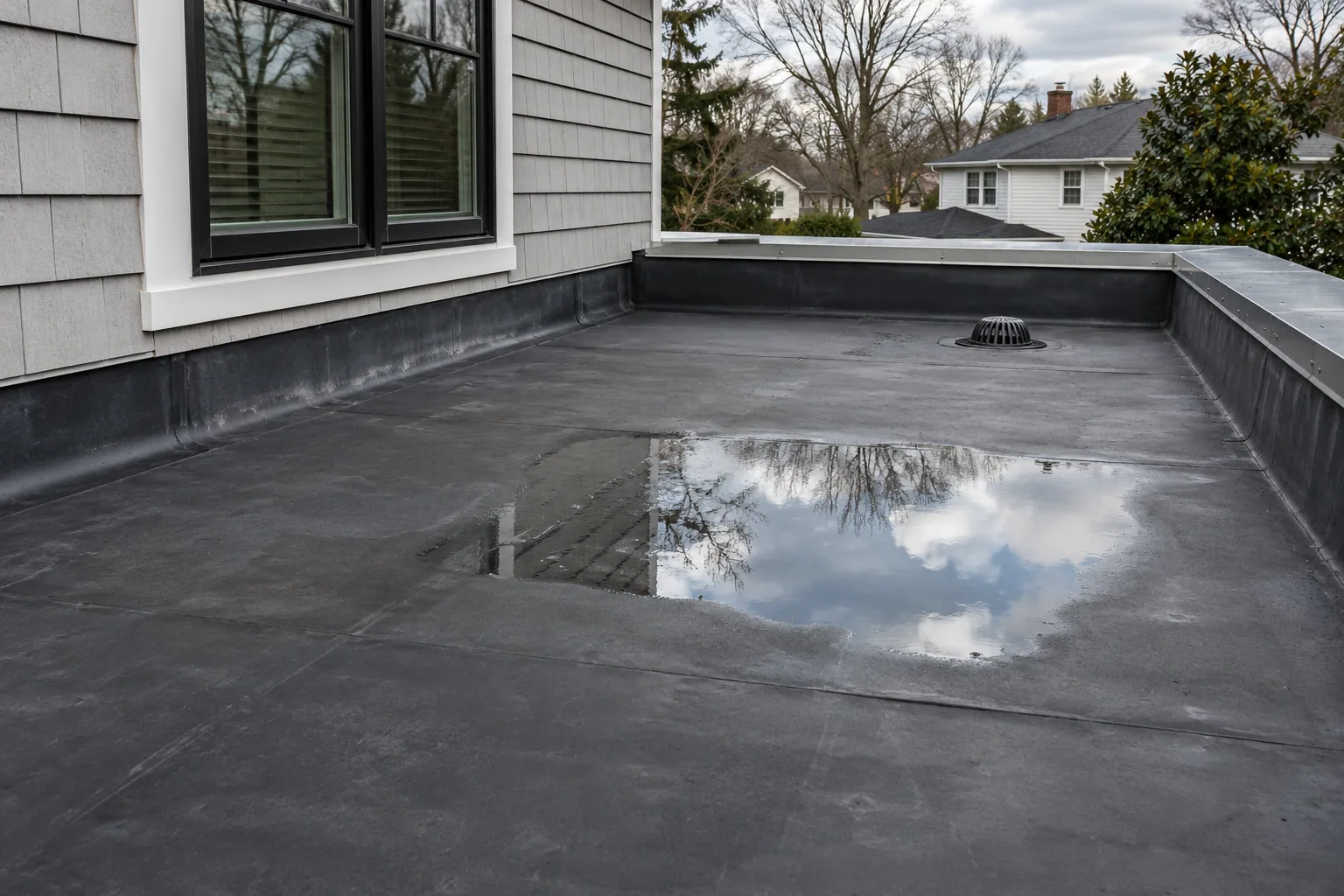
A low-slope roof is designed to manage water, even though it may look flat from the ground. Repeated standing water deserves an investigation into drainage, roof shape, and the condition of the roofing system.
The practical goal is not to select a coating from a photograph. It is to understand why water remains, what the roof assembly can tolerate, and which work addresses the cause.
Document without walking through the water
Do not access a roof just to measure a puddle. A wet membrane can be slippery, and water can conceal damaged areas or unexpected changes in the surface.
If the roof can be seen safely from an existing window or other normal viewing position, take photographs from there. Record the end of rainfall and take another image later from the same viewpoint. Note whether the area recurs and whether its extent changes.
If you cannot see the roof safely, report the indoor symptoms and ask for professional access. A useful inspection does not require a homeowner to create a fall hazard.
Give the water pattern context
Record where the standing water appears relative to visible drains, roof edges, walls, and rooftop equipment. If interior staining occurs, photograph it separately and note its timing.
Tell the contractor about recent roof work, new equipment, repeated drain blockages, and prior repairs. A change in drainage after another project is useful information even when the cause remains uncertain.
Do not infer that water visible near a stain must be entering directly above it. As with sloped roofs, the path through the assembly can be less obvious than the interior mark suggests.
Ask for a drainage and membrane assessment
A professional evaluation should consider outlets, debris, roof slope, low areas, penetrations, seams, flashing, and the condition of the existing membrane. Some investigations may require additional assessment of concealed materials or structural conditions.
Carlisle's spring roof-maintenance guidance provides manufacturer background on inspecting and maintaining membrane roofs. Follow the requirements for the actual system installed on your property rather than applying another product's rules.
Ask the contractor to distinguish observed findings from possibilities. “There is recurring water here” is a finding; the reason may require further investigation.
Understand the limits of a surface treatment
A coating may be one option for some roof systems and conditions. It does not automatically change the roof's geometry, clear an underground drain, or restore damaged underlying materials.
GAF's discussion of coatings versus replacement notes that ponding conditions can affect coating suitability. Ask for a product-specific recommendation and the reasoning behind it.
Avoid treating any standing-water time threshold as a universal warranty rule. The existing system, manufacturer's requirements, and actual condition need review.
Compare the scope, not just the material
A useful proposal identifies drainage corrections, membrane repairs, flashing, any proposed coating or replacement system, and remaining limitations. It should explain how concealed damage will be handled and which tasks need separate specialist involvement.
Our roof estimate checklist provides general comparison questions. The material details for a low-slope roof will differ from a shingle roof.
Questions homeowners ask
Is every puddle a sign that the roof must be replaced?
No. Persistent or recurring water calls for evaluation, but it does not establish the required scope by itself.
Should I drill a hole or add an outlet?
No. Roof drainage changes affect the assembly and discharge route and require a planned professional solution.
What if water is entering indoors now?
Report it promptly and keep people away from unsafe ceilings or electrical hazards. See our leak guide and storm checklist.
Arrange a low-slope roof evaluation
Royal One Construction provides flat roofing in New Jersey. Share the water pattern, photos, and any active leak through the estimate form so the inspection can address both drainage and roofing conditions.